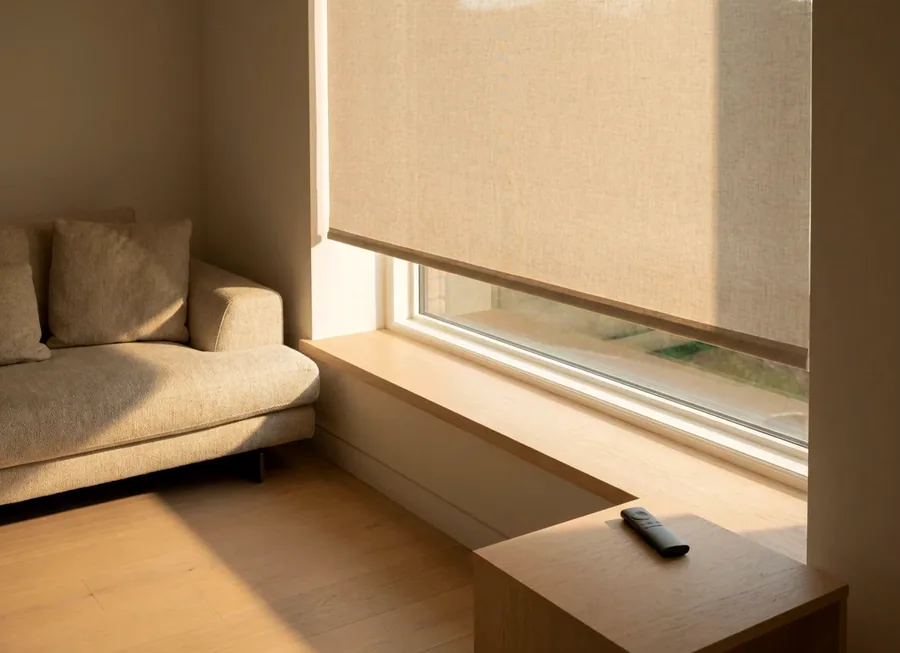
The single upgrade that makes the most sense while your home is still mid-build — wired in cleanly before the ceiling closes up, controlled from one app for every blind in the house.
01
Wired or battery — the new-build case
On a new build, a wired 220V motor is usually the better call: your electrician is already on site, the chase can be planned into the wall before it's plastered, and you get a permanent system with nothing to charge. Rechargeable battery motors remain the right answer for windows added after transfer, or anywhere running a cable isn't practical.
Either way, the earlier the automation conversation happens relative to your build programme, the cleaner and cheaper the installation.
02
Control that matches how you actually live
A handset remote covers the basics. App control lets you check "did I leave the west blinds up?" from the office. Schedules drop west-facing blinds automatically as the highveld sun swings around in summer, and sun sensors do the same job without you setting a timer at all. Wind sensors matter most on exterior products — they retract awnings and external screens ahead of a highveld thunderstorm, which is asset protection as much as convenience.
03
Where it stops being optional
Spans too wide or heavy for a chain, blinds above a stair void or double-volume wall, concealed ceiling-recess systems, and any wall of glass you'd rather control with "one button, six blinds" — these are the situations where motorisation is the only practical answer, new build or not.
No dangling chains — the most child-safe operation there is
Battery motors need a periodic charge — we set that expectation plainly at quote stage, so it's never a surprise later.
04
What motorisation costs
Motorisation has no price of its own, because what you are buying is a product with a motor inside it. Across the range fitted on these houses, motorised shading runs roughly R2,500 to R7,500 per square metre installed: a motorised roller blind at R2,500 to R3,800, a motorised cellular blind at R3,000 to R4,800, and a motorised concealed or recessed system at R3,200 to R5,000.
Small openings are charged at a minimum whatever drives them, and a wired motor planned in while the house is still being finished is a different job from a battery motor retrofitted afterwards. Which one suits your build, and what each window comes to, is settled at the free measure and confirmed in writing.
Motorisation is the upgrade we fit most often while the electrician's still on site — across Helderfontein Estate, Fourways, Dainfern, Broadacres & Cedar Lakes and Steyn City alike.